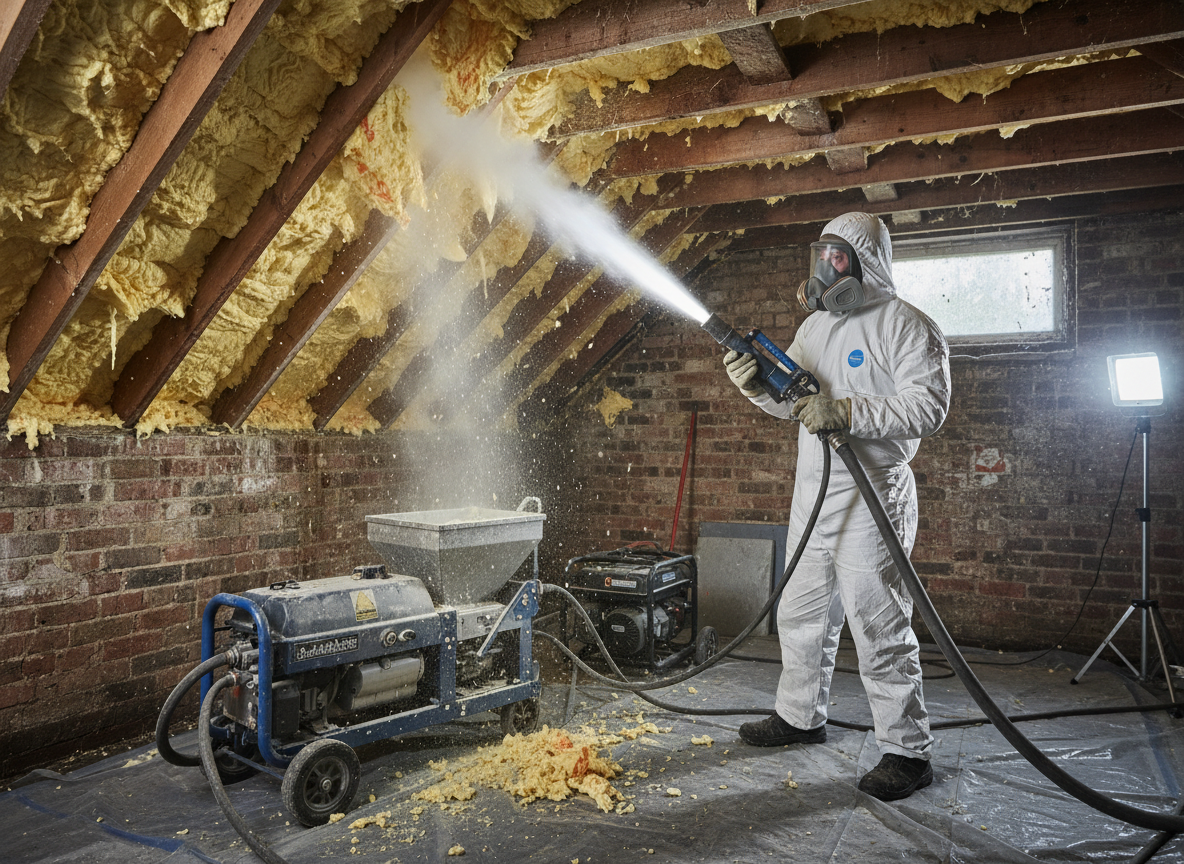
Dry ice blasting removes spray foam insulation without introducing moisture, which matters in Cheltenham where many Georgian and Victorian terraces in areas like Montpellier and Lansdown retain original timber and plaster that can be damaged by wet methods. The process uses solid CO2 pellets accelerated at high velocity to fracture the foam while it sublimates, leaving no secondary waste that must be hauled from tight loft spaces common in GL50 postcodes. Operators must monitor substrate temperature because older Cheltenham brickwork holds ambient moisture that can flash-freeze and cause micro-cracking if dwell time is too long.
Edge cases arise in properties near the Cotswold escarpment where wind-driven rain increases loft condensation; residual foam often bonds more tightly to rafters here than in drier inland sites. Dry ice avoids the dust plume created by mechanical scraping, an advantage when working above occupied rooms in terraced housing where party walls transmit sound and fine particles. Code considerations include ensuring adequate ventilation during blasting because CO2 displacement can occur quickly in enclosed roof voids typical of Cheltenham's two-storey plus attic builds.
Material Compatibility Notes
Dry ice works on polyurethane and polyisocyanurate foams found in local retrofits but requires lower pressure settings on lime-plastered ceilings to prevent delamination. Never use on polystyrene boards, which melt rather than fracture under the thermal shock.
Seasonal Timing Guidance
Winter calls for pre-heating the workspace because sub-zero pellet temperatures combined with Cheltenham's typical 4–7 °C loft conditions can extend dwell times and increase energy use. Summer humidity raises the risk of re-condensation on chilled surfaces after blasting, so jobs are often scheduled for early morning when external temperatures are lowest.
Technician insight
In Cheltenham, the thing that catches most people out with dry ice blasting spray foam removal is the hidden moisture trapped behind foam in pre-1919 Montpellier terraces. When we hit those walls with pellets the sudden temperature drop pulls water to the surface and can lift lime plaster if we do not pre-dry the space first. Older rafters also sit at odd angles, so pellet angle matters more here than on newer trusses.
Montpellier Terrace Loft Clearance
Homeowner in a 1850s terrace reported musty smells after spray foam had been installed ten years earlier. We found the foam had bridged a blocked gutter and trapped water against the party wall. Dry ice blasting fractured the saturated sections cleanly without wetting the adjacent plaster; we removed all material and left the loft ventilated. The smell disappeared within a week and no further damp treatment was required.
How it works
- 1
Site Assessment
Inspect foam type, depth, and substrate condition in the Cheltenham property loft or cavity.
- 2
Containment Setup
Seal adjacent rooms and install extraction to manage CO2 and dislodged particles.
- 3
Blasting Execution
Apply dry ice pellets at calibrated pressure, working in sections to avoid substrate damage.
- 4
Debris Removal
Vacuum fractured foam and wipe surfaces, then ventilate the space before handover.
- 5
Final Inspection
Check for remaining insulation and confirm substrate integrity before leaving site.
Pricing
Cost depends on foam thickness, access difficulty in Cheltenham lofts, and property size; we provide upfront quotes after inspection.