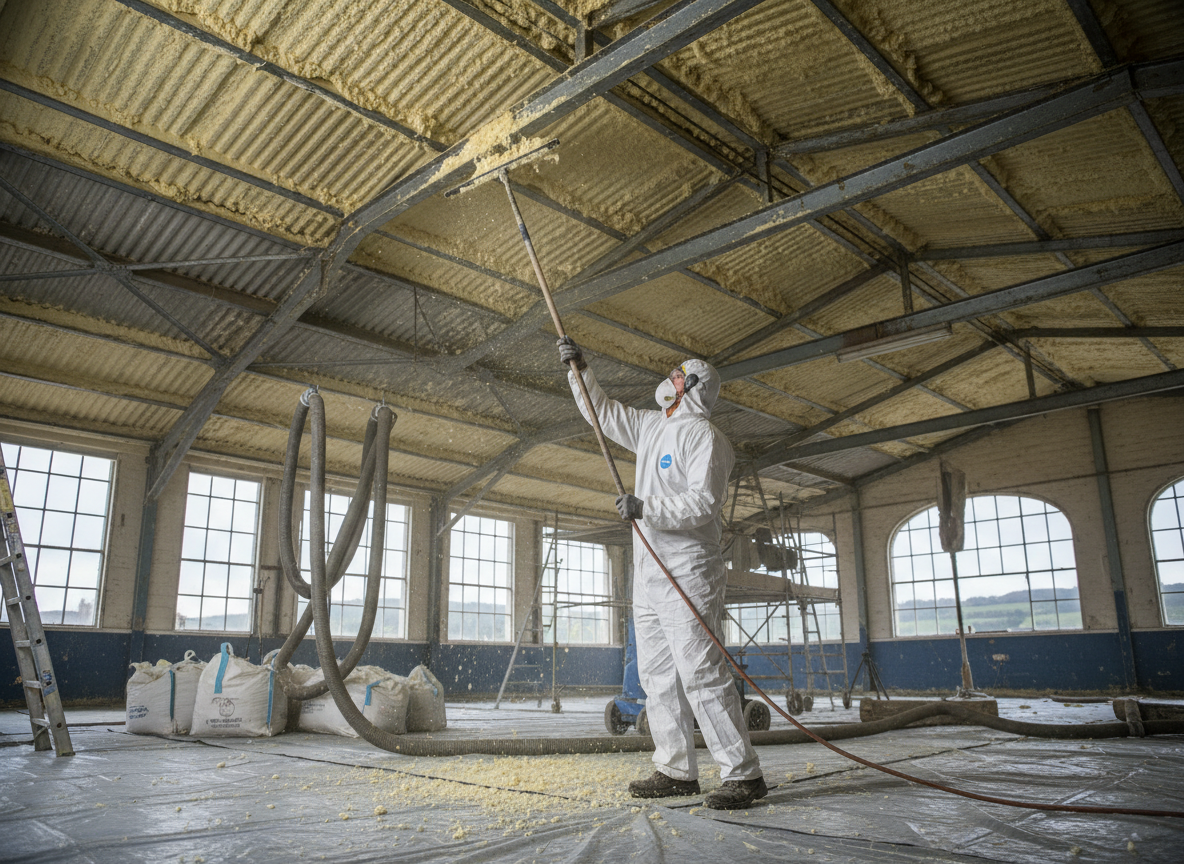
Commercial properties in Cheltenham often feature older Regency and Victorian stock mixed with later conversions around Montpellier and the town centre. Spray foam installed in these buildings can trap moisture against original brickwork and timber, leading to hidden decay that only appears once the foam is cut away. Removal requires careful sectioning to avoid damaging load-bearing elements or disturbing neighbouring tenancies, especially in multi-unit commercial terraces where party walls share insulation layers.
Gloucestershire weather brings frequent damp periods that accelerate foam degradation and mould growth behind commercial roof voids and wall cavities. Technicians must account for limited access points typical in converted high-street buildings and plan phased extraction to keep businesses operating where possible. Waste must be double-bagged on site because cured foam fragments easily and can contaminate drainage systems if not contained during transport through narrow Cheltenham back lanes.
Edge cases include foam bonded directly to asbestos-containing ceiling tiles or around electrical trunking in 1970s light-industrial units on the outskirts. In these situations the process pauses for licensed testing before mechanical removal begins, preventing fibre release into occupied spaces below. Post-removal inspection often reveals original ventilation routes that were blocked by the foam, requiring reinstatement to meet current building standards for commercial occupancy.
Technician insight
In Cheltenham, the thing that catches most people out with Commercial Spray Foam Removal is how Regency-era buildings around Montpellier Terrace often have foam sprayed straight onto original horsehair plaster that starts crumbling the moment you start peeling the foam back.
Converted Office Unit in Central Cheltenham
Foam in a first-floor commercial unit had trapped moisture against a shared wall, causing plaster failure. Inspection showed the foam extended into a hidden roof void above the neighbouring shop. We isolated the area, removed the foam in sections, and reinstated ventilation without interrupting the ground-floor business.
How it works
- 1
Site Assessment
Detailed inspection of the commercial space to map foam depth, substrate condition and access constraints in Cheltenham properties.
- 2
Containment Setup
Installation of dust barriers and negative pressure zones to protect adjacent business areas during extraction.
- 3
Foam Extraction
Sectional cutting and mechanical removal of foam while preserving original building fabric where possible.
- 4
Waste Removal and Cleanup
Double-bagged disposal followed by vacuuming and surface treatment to leave the space ready for follow-on trades.
Pricing
Upfront quotes provided after site inspection; cost driven by foam volume, access difficulty and substrate condition.