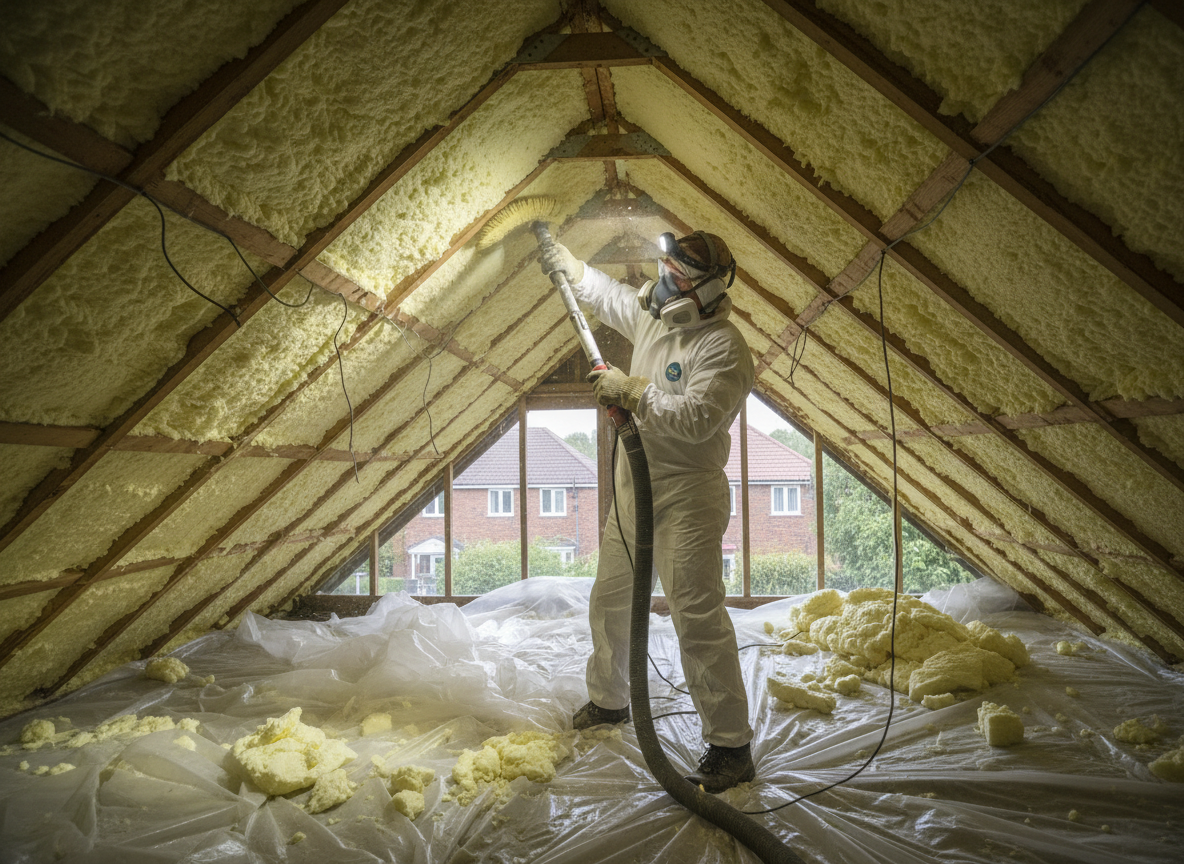
Open cell spray foam bonds tightly to rafters and joists in Cheltenham’s Victorian and Regency terraces, making removal slower than in newer builds. The material absorbs moisture readily, so any roof leak in Montpellier or Pittville properties can leave saturated foam that must be cut out in sections rather than pulled in sheets. Workers wear full-face respirators because the foam releases fine particulates when disturbed, and dust can drift through lath-and-plaster ceilings into living spaces below.
Access is often limited to small loft hatches in terraced homes along the Promenade or Lansdown. This forces technicians to break the foam into manageable blocks using oscillating tools before bagging it for off-site disposal. In winter months, when temperatures drop and lofts become colder, the foam becomes more brittle and shatters into smaller pieces that require extra vacuum passes. Homeowners in the GL50 postcode frequently discover the foam was applied over original insulation, adding an extra layer that must be separated before the space can be re-insulated with modern materials.
Electrical cables and pipework hidden inside the foam are common in pre-1930 Cheltenham houses. Each run must be traced and protected before cutting begins, otherwise live wires can be nicked and require an electrician call-out. After removal the rafters are brushed and vacuumed to remove residue that would otherwise prevent new insulation from sitting flat. Final checks include confirming no foam remains lodged between ceiling joists that could affect ventilation or cause future damp issues.
Technician insight
In Cheltenham the thing that catches most people out with open cell spray foam removal is how the narrow loft hatches in Regency terraces force us to cut the foam into much smaller blocks than we would in a modern detached house, doubling the time spent bagging and vacuuming.
How it works
- 1
Site Assessment
Technicians visit the Cheltenham property to measure foam depth, check for hidden services, and confirm roof access routes.
- 2
Containment Setup
Dust barriers and negative-air machines are installed to stop particles migrating into living areas of the home.
- 3
Sectional Removal
Foam is cut into blocks using oscillating blades and removed through the loft hatch or external access points.
- 4
Clearance and Vacuum
Remaining residue is brushed from timbers and HEPA-vacuumed before barriers are taken down.
- 5
Waste Disposal
Bagged material is transported from the GL50 address to licensed disposal facilities.
Pricing
Final cost depends on foam depth, loft access difficulty, and whether hidden services require extra protection in Cheltenham terraces.