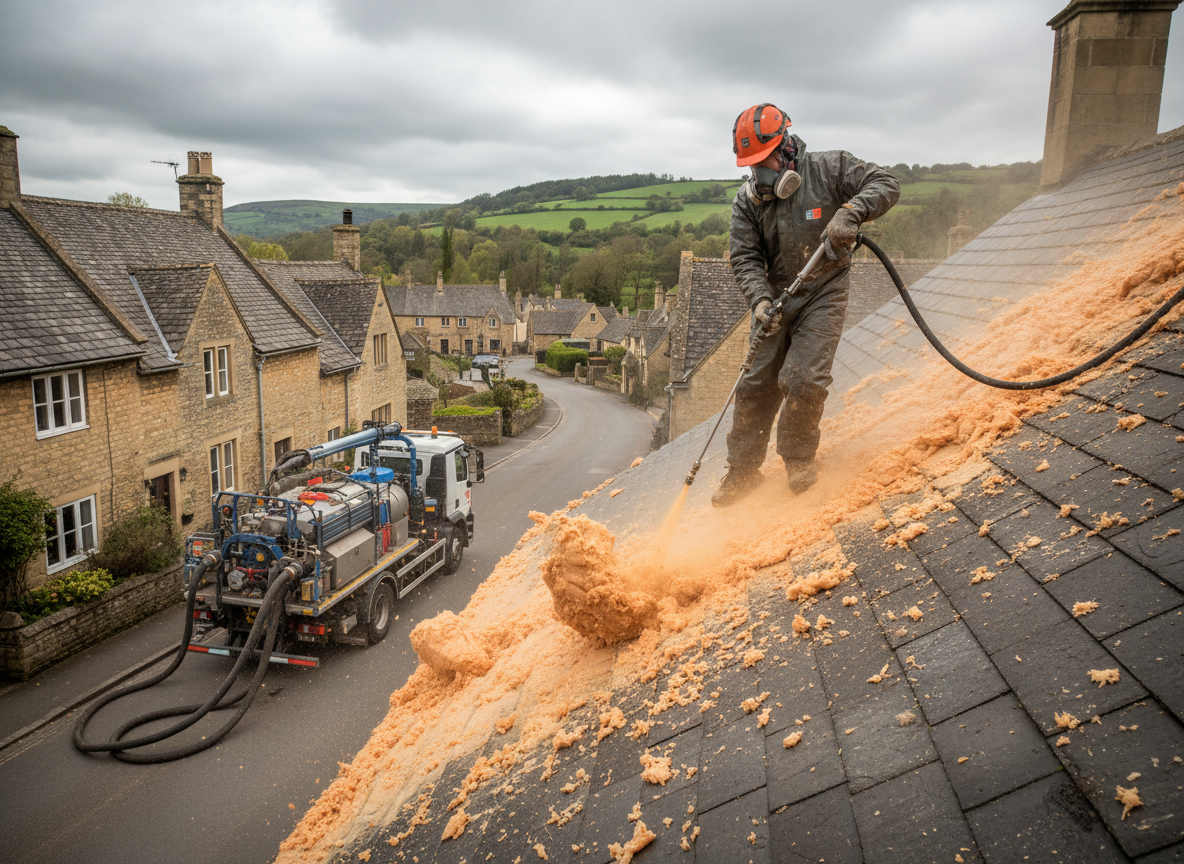
Cheltenham's Victorian and Edwardian terraces in Montpellier and Pittville often received spray foam on pitched roofs decades ago to combat heat loss. Over time the closed-cell material traps moisture against rafters and battens, accelerating rot in the damp Gloucestershire climate. Removal requires careful cutting and vacuum extraction to avoid disturbing original lath and plaster ceilings below while protecting the slate or tile covering that is typical on these properties.
Edge cases arise when foam was applied over existing insulation or around chimney stacks common in the area. The foam can conceal corroded lead flashings or blocked gutters that funnel rainwater directly into the roof void. Technicians must inspect for these hidden defects during stripping and ensure the roof deck is fully dried before any new ventilation or insulation is considered.
Local building regulations require that any work affecting the thermal envelope of listed or conservation-area properties in Cheltenham is documented. Removing foam changes the roof's performance, so ventilation upgrades are often needed to meet current standards. Homeowners should expect debris removal, dust containment and a final inspection of the roof space to confirm no residue remains that could affect future re-roofing.
Access on narrow terraced streets like those around Montpellier Terrace limits the size of equipment that can be brought in. Work is frequently staged from inside the loft with debris lowered through a controlled chute to a skip positioned on the road, minimising disruption to neighbours and traffic.
Technician insight
In Cheltenham, the thing that catches most people out with roof spray foam removal is how the foam was often sprayed right up to the eaves on Victorian terraces around Montpellier Terrace. Once winter rain starts driving in, any small gap left during removal lets water track along the wall plate and you end up chasing rot you did not see at first.
Montpellier Terrace Terrace Roof
Homeowner noticed musty smell in top-floor rooms after heavy autumn rain. Inspection found closed-cell foam trapping moisture against rafters in a 1890s terrace. We stripped the foam in sections, dried the timber, confirmed no active rot and left the loft ready for improved ventilation.
How it works
- 1
Initial Loft Inspection
Assess foam depth, rafter condition and access points from inside the roof space.
- 2
Containment Setup
Install dust barriers and negative air to protect living areas below during removal.
- 3
Foam Extraction
Cut and vacuum foam in sections, checking for hidden moisture or timber damage.
- 4
Clearance and Ventilation Check
Remove all residue, inspect for ventilation needs and confirm the roof space is clean.
Pricing
Pricing varies by roof size, foam thickness and access constraints; we provide upfront assessments from our Montpellier base.