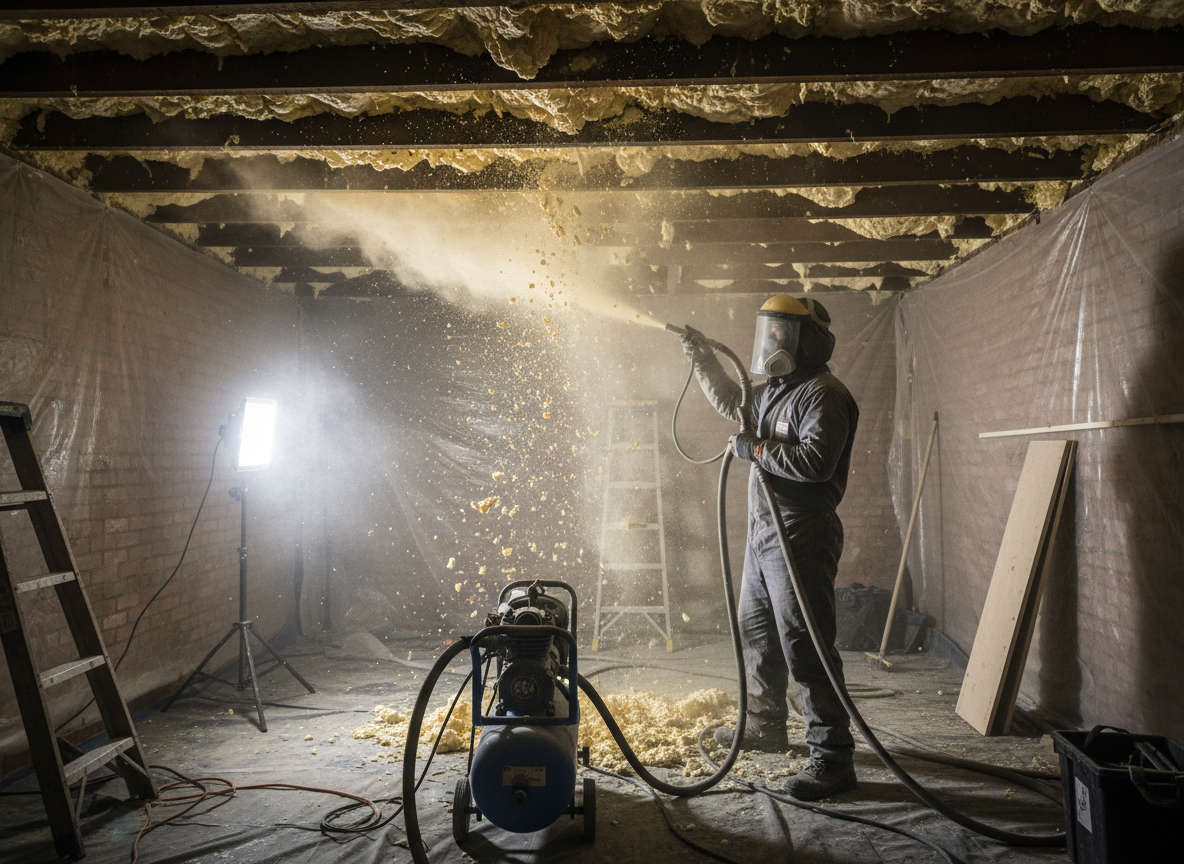
Sand blasting removes cured spray foam from timber joists, brickwork and concrete in Cheltenham's older properties without excessive substrate damage. Regency terraces and Victorian villas around Montpellier and Lansdown often have foam applied directly to lath or exposed rafters, where high-pressure media can strip paint layers or erode soft mortar if nozzle distance and grit grade are not adjusted for each surface. Damp Gloucestershire winters allow moisture to migrate behind the foam, creating hidden mould that must be addressed during extraction to prevent recurrence once the insulation is gone.
Edge cases include foam that has expanded into electrical chases or around chimney breasts common in pre-1919 Cheltenham stock. Operators must isolate circuits and use lower pressures near historic plaster to avoid cracking. Post-removal inspection frequently reveals failed felt or slipped tiles on roofs above the treated loft, a direct result of the original foam installation trapping condensation. Proper dust extraction and HEPA filtration are essential because the fine polyurethane particles generated travel easily through the interconnected roof voids typical of terrace rows.
Local building control expectations in the Cheltenham area require that any exposed timber be assessed for rot before new insulation is considered. Sand blasting leaves a textured surface that accepts new vapour-open treatments better than mechanical scraping, but residual foam dust must be fully removed from mortar joints to avoid future adhesion problems. Homeowners in the GL50 postcode often discover the need for this work only after a survey flags non-breathable insulation during a sale.
Technician insight
In Cheltenham the thing that catches most people out with sand blasting spray foam insulation removal is how the foam has wicked into the soft lime mortar of 19th-century terrace walls; one extra pass at the wrong angle and you lose pointing that then needs repointing before winter rain sets in.
Montpellier Terrace Loft Extraction
Foam in a Regency terrace loft had trapped moisture against rafters and started to degrade the felt. Assessment showed expansion into two electrical chases. We isolated power, contained the space, used reduced-pressure blasting on the brickwork and finished with full debris extraction, leaving the timbers clean for inspection.
How it works
- 1
Site Assessment
Inspect foam depth, substrate condition and access points in the specific Cheltenham property, noting any electrical or chimney proximity.
- 2
Containment Setup
Seal rooms and install negative-pressure dust extraction to protect the rest of the house and neighbouring terraces.
- 3
Sand Blasting Removal
Apply calibrated media at controlled pressure to strip foam while preserving underlying timber and masonry.
- 4
Debris Clearance and Final Clean
Vacuum all residue, wipe surfaces and dispose of waste in line with local Gloucestershire requirements.
Pricing
Upfront quotes follow a site visit; final cost depends on access difficulty, foam thickness and extent of hidden damage in Cheltenham properties.